X 1 2 3 4 5 6 7 8 9
The Osireion
introduction
X 1 2 3 4 5 6 7 8 9 |
The Osireion |
introduction |
The Osireion at Abydos

The Osireion Re Discovered
"Can you hunt the prey for the lion,
Or satisfy the appetite of the young lions,
When they crouch in their dens.
And lie in wait in their lair?"
- Job 38:38,40
Testimony of CoinsThe previous material on "the texts" places the Osireion in the hands of a select few, charging them with the sacred responsibility of preserving the integrity of the place through Antiquity. But Leviathan was gone, and its secret excised; that is, until Alexander the Great conquered Egypt circa 333 BC and left the descendents of his best general, Ptolemy Soter, upon the throne as the Ptolemy dynasty.
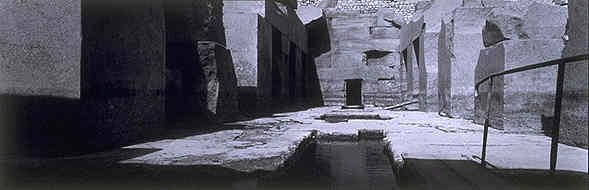
During the Ptolemy's rule, and later during the Roman Empire, the Osireion was not without its visitors. Each such visitor left a coin of the day. The collection was cataloged by the archaeologist Henry Frankfort, and stands as silent testimony to the awe with which the Osireion inspired its visitors. The list follows, keyed to the ruling monarch and the number of coins left:
Ptolemy II - 6
Ptolemy III - 8
Ptolemy IV - XIII - 18
Ptolemy X - 1
Ptolemy XIII - 2
Cleopatra VII - 8
Barbarous copy - 1
Claudius - 6
Domitian - 1
Antonius Pius - 1
Constantius II - 1
(In the Central Hall) "...there were also about thirty fragmentary or decayed pieces of metal which had once been coins: three appeared to have been late Ptolmaic, one probably of Augustus, one of Claudius, and one of Vespasian; only one looked like third century Roman. ... The conclusion to be derived from these coins is that the part of the site where they were found was frequented throughout the Ptolmeic period and the first half of the first century A.D. but was seldom visited afterwards."
Who was it, left these coins in silent tribute through the Ages, at this most awesome of stone artifacts? Was it a secret cult; was it a single family? My guess is that it was the Ptolemies. They were a powerful family in Macedonia when Alexander the Great came to the throne; Ptolemy I was a general under Alexander, and was made Pharaoh of Egypt when Alexander conquered it. As Pharaoh, they knew the secret of Leviathan, and how the Hebrews had taken the Ark of the Covenant; with Leviathan inside. (According to Hebrew tradition, (1) the Ark was the size of a large portable dog kennel. The Ark, coincidentally, was cared for by the Levites, priestly functionaries; or literally meaning "guardians of Leviathan.") Still, the Ptolemies did not know Leviathan's real secret.
NOTE: When the Etruscans left Egypt, after their Civilization was destroyed with the loss of the Osireion and the aqueduct that was their only water supply, they settled in a place that came to be known as Troy. Over the next three millennia Troy was wiped out a dozen times; but each time was rebuilt. Eventually, they pretended to be all gone but had migrated into some remote hills of Greece known as Macedonia. One of their Great Houses were the Ptolemies, who came back to Egypt after Alexander conquered it and remained in power until Cleopatra was dethroned (she then commited suicide by having herself bitten by poisonus asps) by Augustus Caesar not long after her lover Julius Ceasar was assassinated on the Ides of March in 44 BC. Cleopatra was the last of the Ptolemies; at least those who were associated with Egypt. (The other twelve Great Houses of Etruscans had settled in central Italy after leaving Troy, a separate city to each as noted on the opening page.)
Not long after the Hebrews left Egypt, Israel had established itself a kingdom by battling all the resident tribes and nation states. It's during this period that they were invincible in battle. Eventually they established a power base and built The Temple in Jerusalem, along similar lines to the Osireion. The first Temple was destroyed in 600 BC; it was replaced by a massive stone Temple. Leviathan was kept in a place beneath the Holy of Holies, i.e. the Tabernacle. This convoluted system of tunnels beneath the Temple, only recently excavated. You can take a guided tour of the excavations. As at the Osireion, the place was supplied with a constant volume of cool water from an underground aquifer.
Leviathan in the Ark
Ptolemy II visited the place one day and noticed the irregularities in the steps carved steps into the Central Hall. Suddenly Pharaoh realized their significance; and deduced that this was done by Leviathan; it was a sentient creature. Thereafter, Ptolemy - and all his successors - schemed to capture Leviathan from the Hebrews, who had kept Leviathan in the Labyrinth below the Temple in Jerusalem. The Ptolemys, perhaps descendents of the People of Job, were extremely upset that the Hebrews might be abusing Leviathan's powers. Until Leviathan was returned, each attempt to free Leviathan was recorded by placing a coin of the Central Hall of the Osireion.
Inscriptions in the Osireion note that Leviathan has a strange affect upon people. The Hebrews were accused of using this to give them an advantage in battles. It's said that while the Hebrews had the Ark, they never lost a battle. According to legend, the Ark disoriented the enemy enough mentally that they were easily defeated. The impression was as if in a religious ecstasy. The ancient Egyptians had used this property to enhance the religious experience of the faithful who came to the Temples.
NOTE: The ultimate fate of Leviathan is not revealed on this website, but only in my novel Roswell. I can give you a hint, though; it has something to do with Julius Caesar's brief invasion of Britain, and the creature we now call the Loch Ness monster, Nellie. Before Britain, Caesar made a brief foray into Germany, building the famous "Bridge over the Rubicon," but apparently this climate was not to Leviathan's linking. So they took her to a remote Loch in Ireland and set her free. She's been happy ever since - and growing! I suspect her natural (and, future) habitat is hyperspace, where she is a dragon just like the myths say. . . .
Bibliography
Frankfort, Henry The Cenotaph of Seti I at Abydos (p. 32-33) 39th Memoir of the Egypt Exploration Society, Oxford University Press, New York