X 0 1 2 3 4 5 6 7 8

Section Four
The U.F.T.
19. Charged
Particles
20. Solid State
AstroPhysics
21. Conduction
Band
22. Bonding
Orbitals
X 0 1 2 3 4 5 6 7 8 |
|
Section Four |
| The U.F.T. |
| ___ |
| 19. Charged Particles |
| 20. Solid State AstroPhysics |
| 21. Conduction Band |
| 22. Bonding Orbitals |
TAB 22 BONDING ORBITALS
The atomic bonds between atoms or molecules are the transitions between fractal levels. These bonds are assumed to be made up of electrons on "free return" paths such that the particles linked are the two primaries in a 3BP and the bonding orbital is the zero velocity curve through the L2 point. Fission need only destabilize this point; fusion need only put a particle in a halo orbit around it.
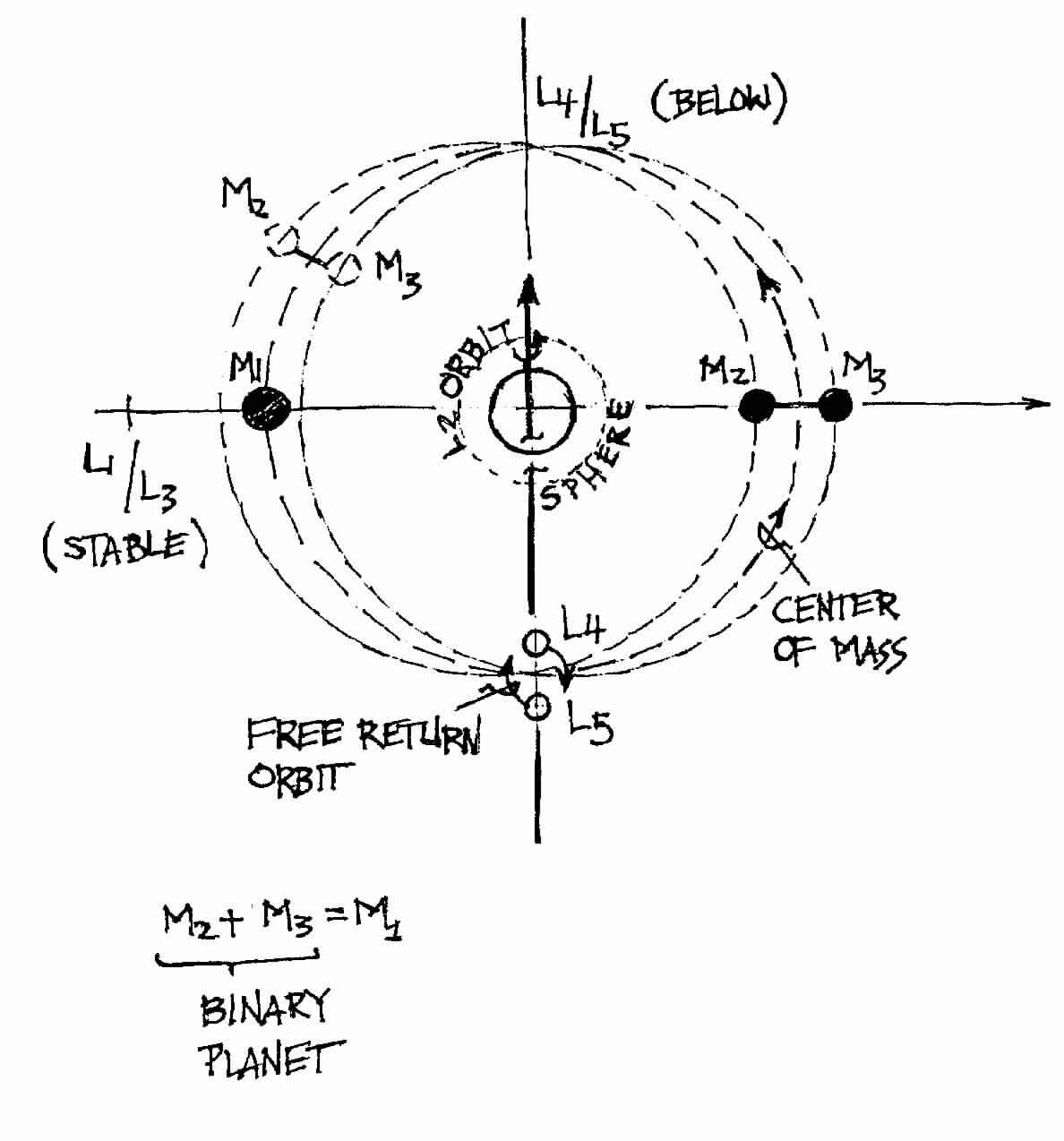
Orbitals Above Higher Energy S Type Bonds
The source of gravitational field force is mass and the source of electrical field force is electric charge. Otherwise they are exactly the same mathematically:
 and
and 
This means that there exists a Three Body Problem on the subatomic level, viz a proton, electron and a third body ~ a proton, if the study is to look at intermolecular bonding. This is similar to the famous Copenhagen problem of celestial mechanics, wherein both massive bodies have unit mass and unit separation. The following illustration shows two nuclei of the same positive charge, with one perhaps having a large mass because of nucleons.
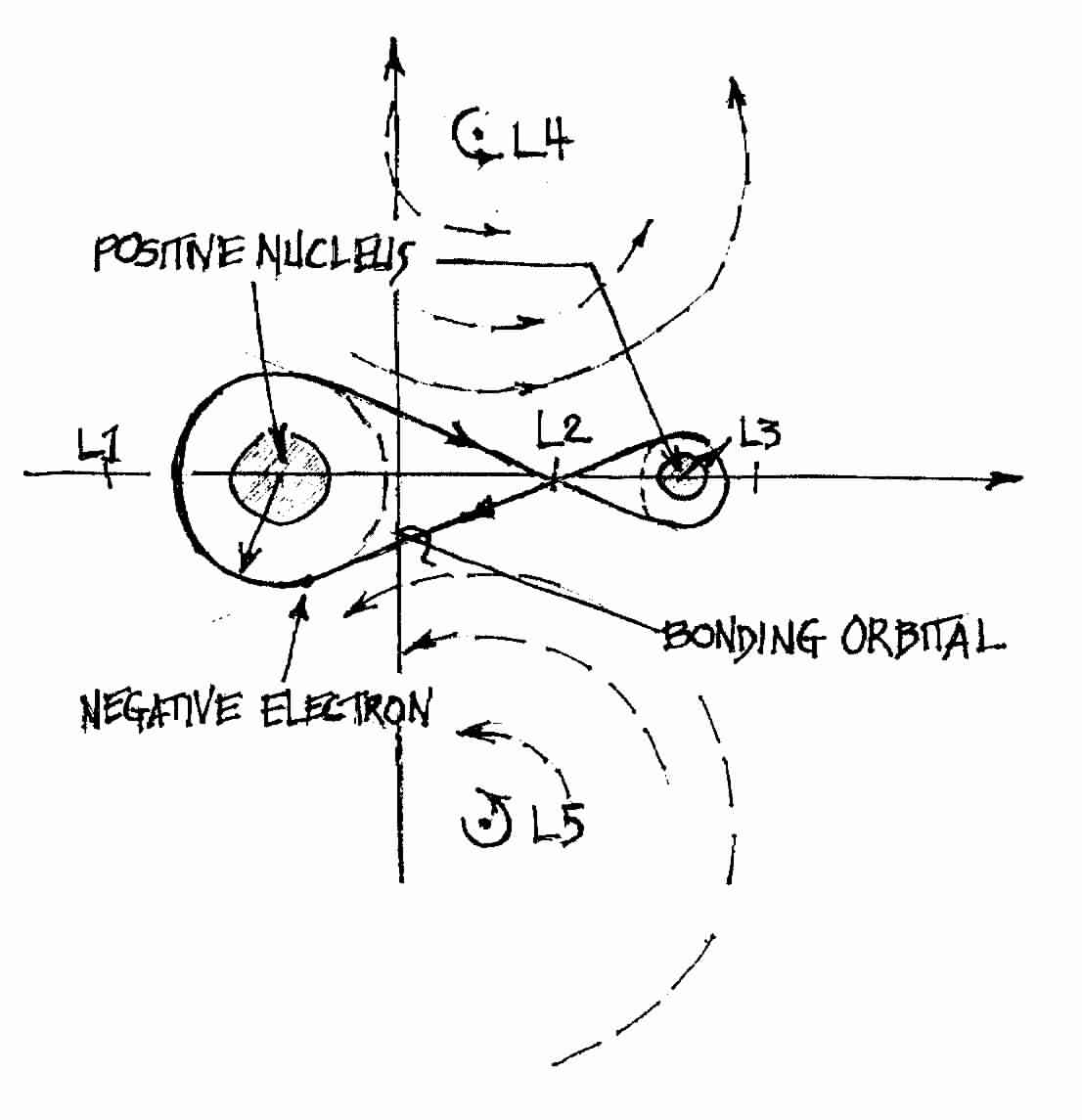
Free Return Orbit as an intermolecular Bond
This illustration shows two positively charged nuclei, with an electron orbiting between them along an equipotential surface. A body on such a surface, by definition, draws no work from the respective electric fields and thus is ideal for a bonding orbital.
The illustration shows the electron orbiting between the two protons, and beneath their respective atomic/electron shells. In this regard, the bonding orbital "shields" part of the nuclear charge (16), perhaps so that one proton in each nucleus is classified as a "neutron: because its electrostatic charge is expended on the bond.
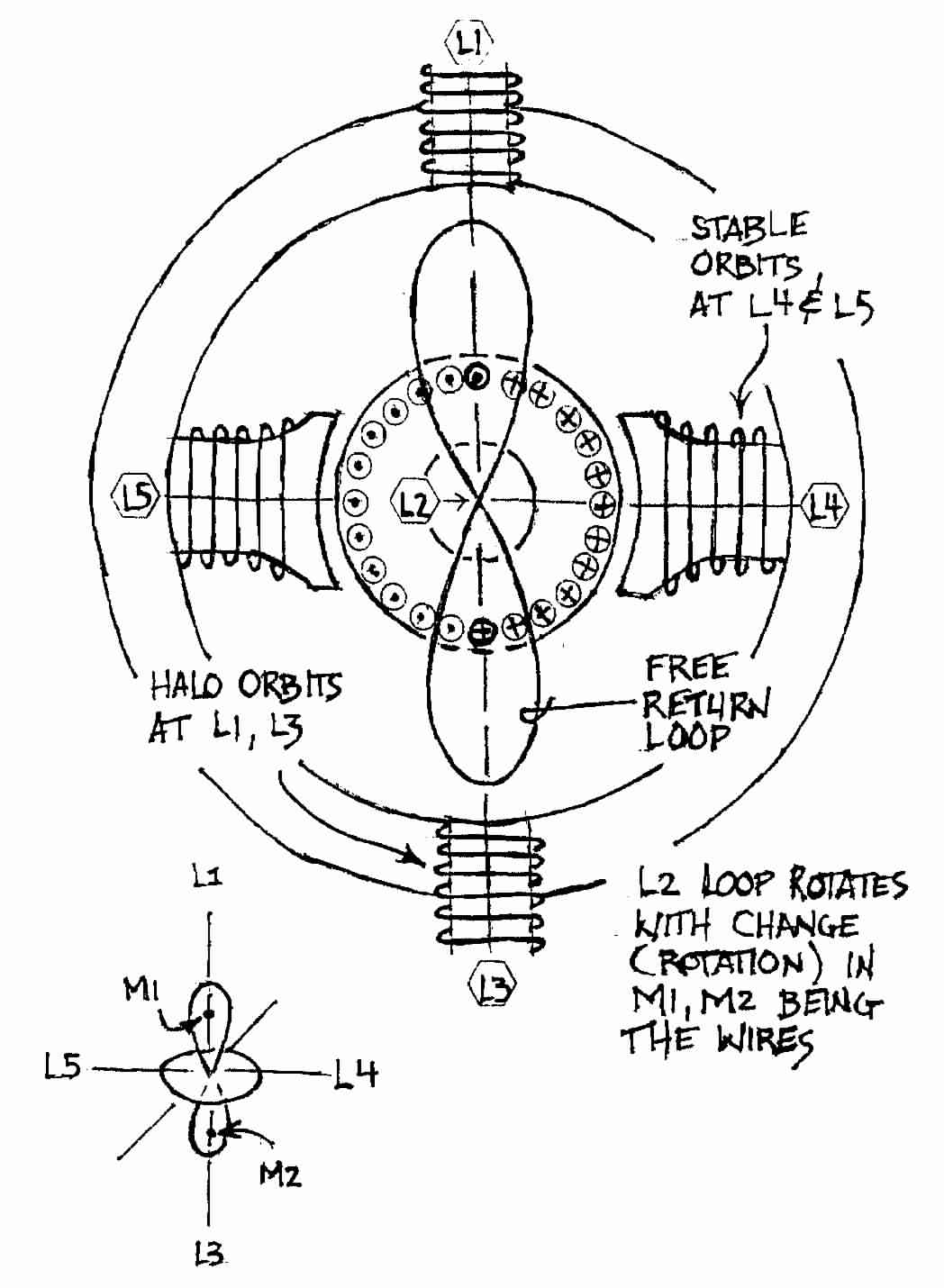
In the figure below the Three Body Problem between two atoms has the five Lagrange stability points (perhaps two more equilateral points in a system that is three dimensional), giving "anchor points" for the atomic electron shells (+/- electron spin?), with perhaps one L4/L5 pair for each unique atom.
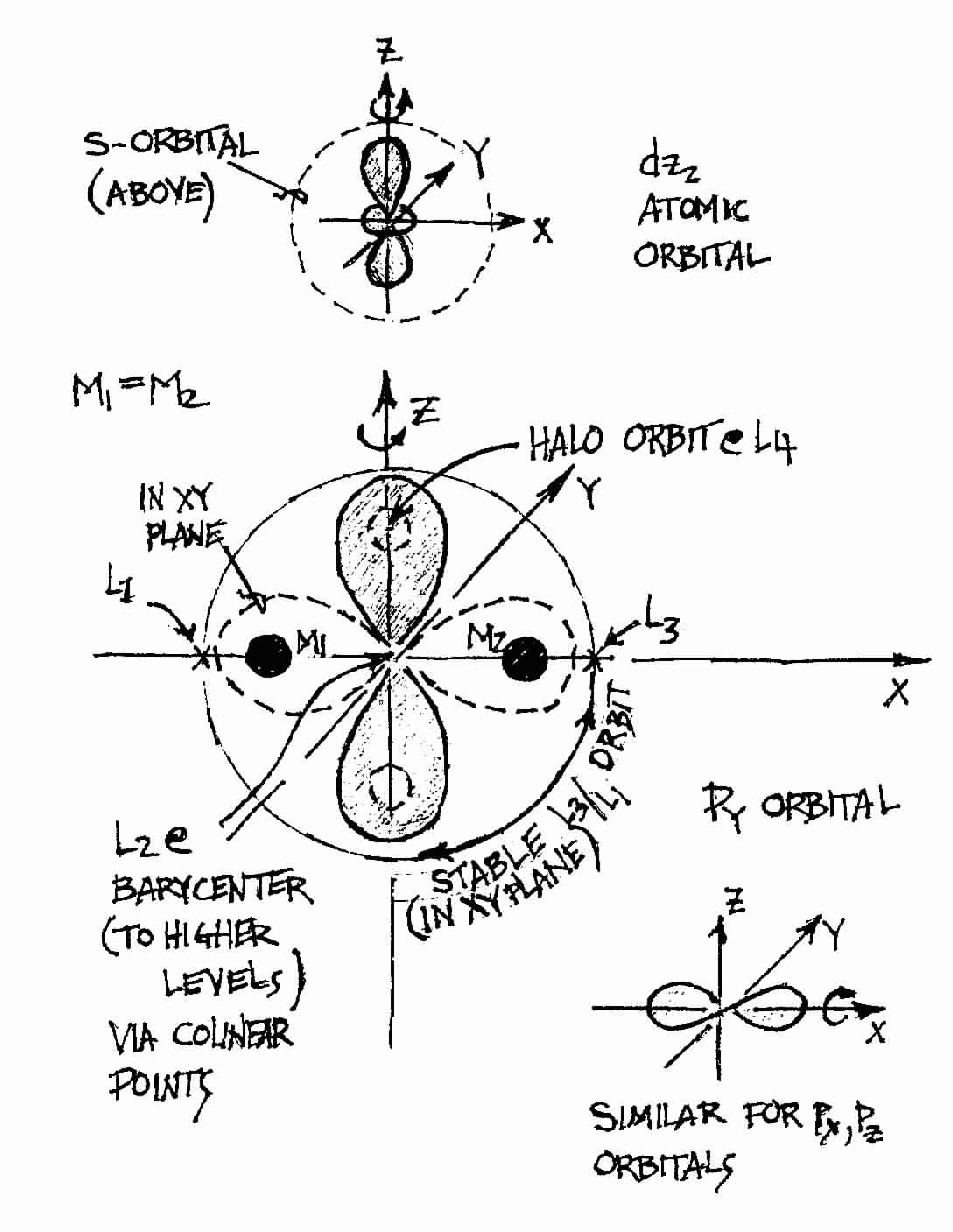
Complex P Type Orbital Bonding
The general idea is to show how Lagrange Points make it possible to next orbitals, along the colinear axis which exists on both levels - the free return figure-8 loop at an L2 point actually forming an orbit between successive levels; the L1 and L3 points just serving as anchor points on either level.
The relationship between successive levels forms higher level Three Body Problems, and create new Lagrange Points unique to the higher level.
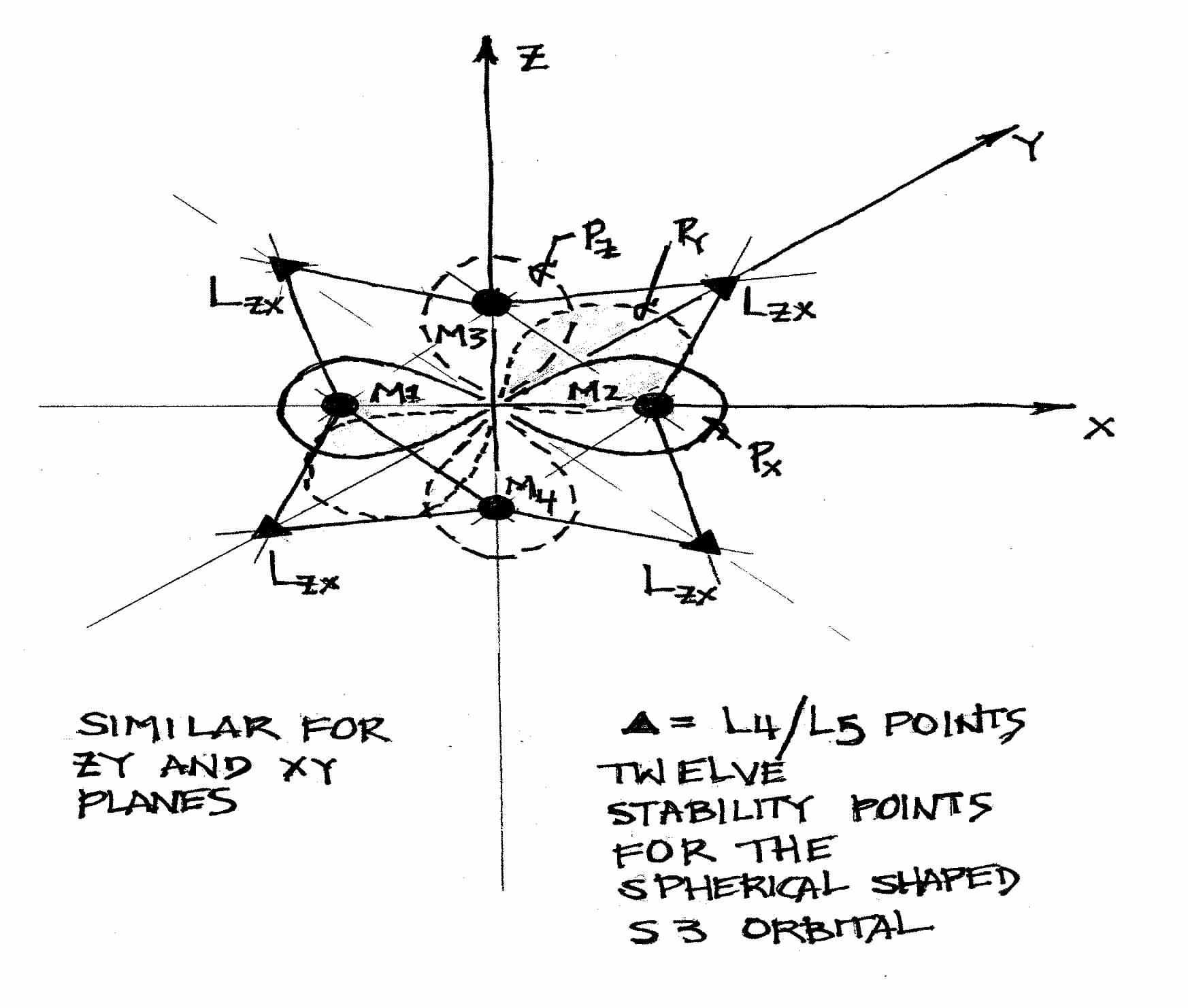
Anchor Points at successive fractal levels
Consider that the quantum 3BP is such that L3 is beyond the barbell shaped orbitals. Then a halo orbit at L3 is a barbell orbit of the next level, i.e. the next higher energy level barbell shaped orbit.
The figure on the following page shows how all this might be modeled in the electromechanical motor/generator scheme that has been cited successfully before. The halo orbits are windings on the stator poles N-S-E-W, at the various Lagrange Points, and the L2 free return orbit centered at the polar axis of the rotor is the operating part of the model, existing at both levels.
Electromechanical interaction of subatomic bonds