X 0 1 2 3 4 5 6 7 8

Section Four
The U.F.T.
19. Charged
Particles
20. Solid State
AstroPhysics
21. Conduction
Band
22. Bonding
Orbitals
X 0 1 2 3 4 5 6 7 8 |
|
Section Four |
| The U.F.T. |
| ___ |
| 19. Charged Particles |
| 20. Solid State AstroPhysics |
| 21. Conduction Band |
| 22. Bonding Orbitals |
TAB 21 The Conduction Band
One of the most unusual phenomena in any physical science is the concept of a "conduction band" in modeling electrical current flow in conductors. There is no theoretical basis for the process in electromagnetic theory or in solid state physics (i.e. the study of the transistor junction). The latter is literally 100% statistics, yet it has a very well defined notion of this "conduction band" in which free electrons from all the metal molecules have no formal association with a specific molecule (as is the case in all other known materials as modeled by all other physical sciences), but instead occupy a theoretical realm in which all of the electrons can move free and effortlessly through the material at close to their maximum possible speed - the speed of light.
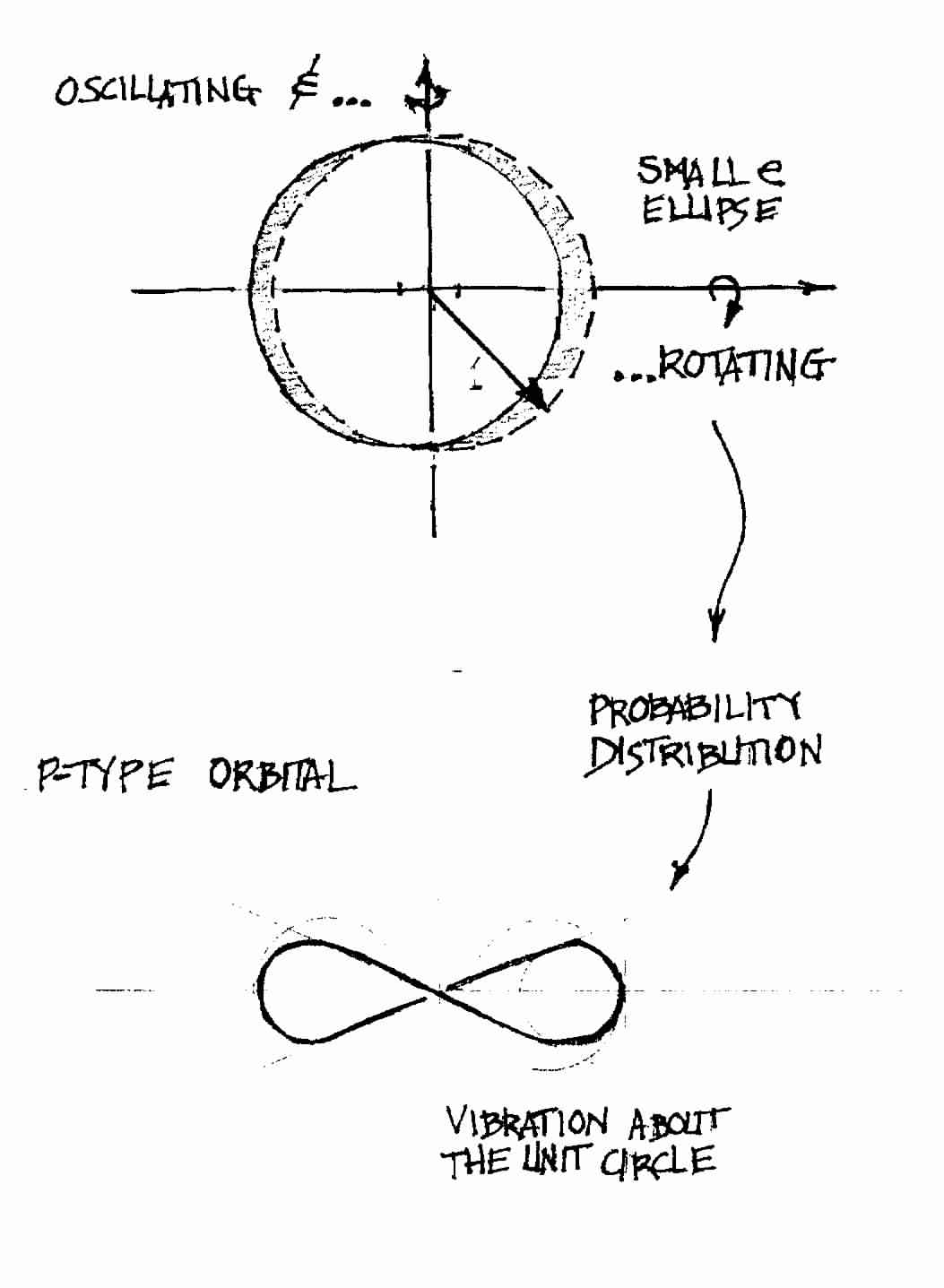
This "conduction band" is endowed with other very special properties, which are not supported by solid state physics theory in the least. Relativity Theory says that any object approaching the speed of light experiences an exponentially increasing mass - even at half the speed of light (c) the mass has increased many fold, much less at near to c itself. Somehow electrons in this "conduction band" can violate Relativity in its entirety.
The only theory that justifies this violation of every precept of Relativity by electrons is the N Body Problem of Celestial Mechanics. Relativity was actually derived long before Einstein
( 11 ) assuming an aether (instead of an electromagnetic field - the old particle mass duality of physics). Einstein's Relativity says motion is impossible near, much less beyond, c, because the object has that point reached an infinite mass value. Poincare's Relativity says motion at c behaves like incompressible fluid flow - i.e. the equations of motion for the N Body Problem - and makes no constraint for motion beyond c, except that thereafter motion is within an incompressible fluid. The universal acceptance of the "conduction band" model shows that Celestial Mechanics is the better science because this idea does not violate any of its laws, much less all of them.The other papers in this section offer analogies from other perspectives, showing how the 3BP and other principles of Celestial Mechanics closely approximate the behavior of subatomic particles - in molecular bonds, atomic orbitals, and in the overall subatomic force structure. Taken together, they make it seem plausible that conductors have some kind of molecular structure that simulates the forces of N bodies upon each small body, giving the "conduction band" idea the feel of incompressible fluid flow at the atomic level. It is possible to show many more parallels between astrophysics and solid state physics, and strive to suggest a discrete - rather than a statistical - model of the transistor junction.
Observe that, once again, the N Body Problem from a large perspective reduces to the 3BP. This implies that once c is reached, space is structured like a 3BP again - and when 2c is reached the N Body Problem is solved, etc.. This is consistent with the 1/r and 1/r2 force criteria established earlier. (ONE) The nature of the fundamental forces changes with each new level, although the physical aspect of bodies in each space is unchanged level to level. Each level is bounded by two planes, one at the minimum (the invariant plane) and the other at the maximum (the symmetric plane). At the next higher level, the minimum is the maximum from the lower level - and conversely for the next lower level.
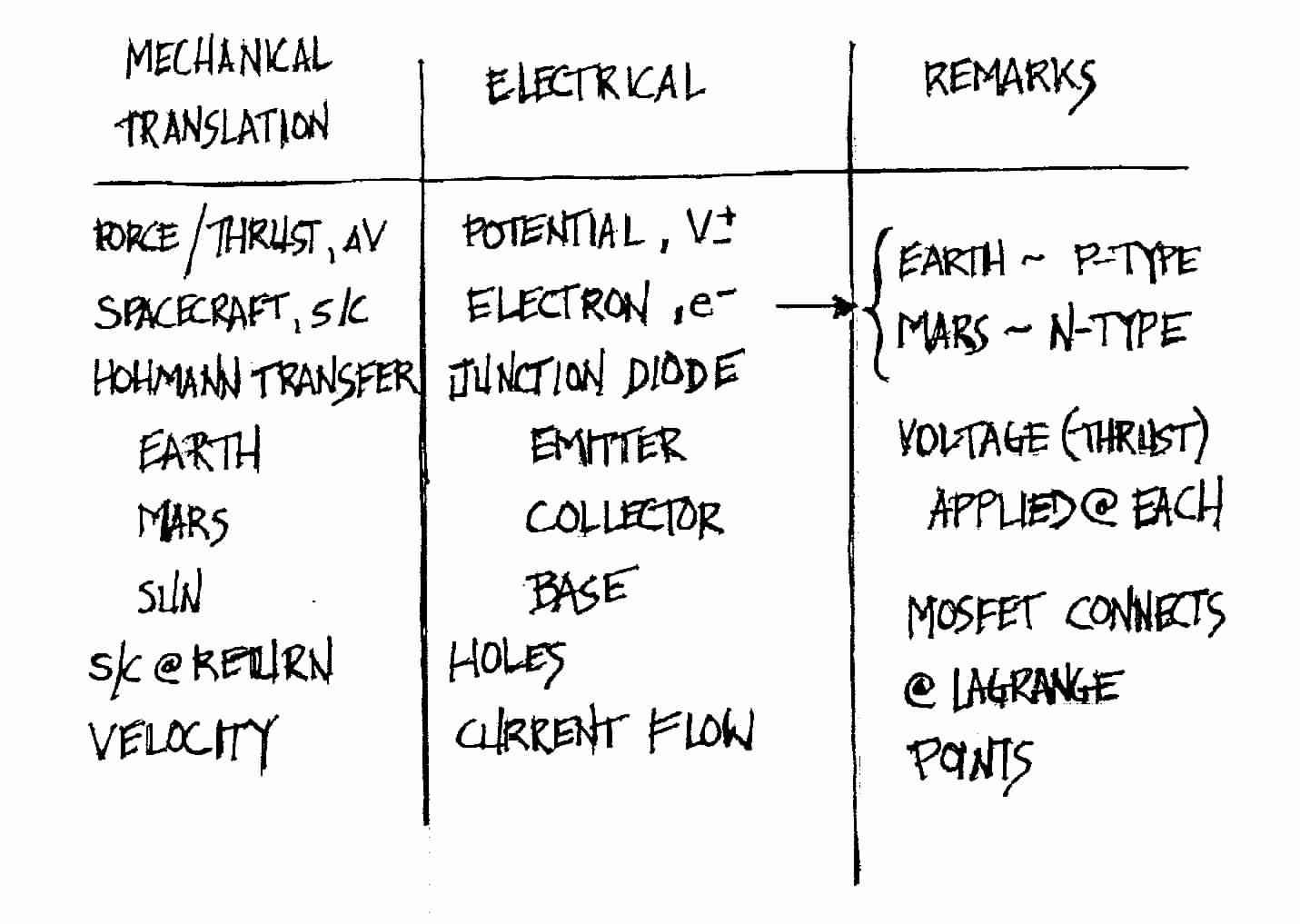
Otherwise, the structure of junction diodes is equivalent to an electron going from a stable orbit in one material across a uniformly charged region to a stable orbit in a second material. Historically, transistors have been optimized by having a small forward bias in three places: across the emitter, the base, and at the collector. This is exactly analogous to the optimum trajectory I have found: a thrust from the initial Earth parking orbit, one at midpoint in the "base" region, and another at the final Mars parking orbit. The electronic model for the junction, as embodied in the Ebers-Moll equations is exactly analogous to this. I have even found what act like Lagrange Points in the more advanced transistors, the BJT and Mosfet. The advances in solid state physics have followed exactly the same lines as those in celestial mechanics.
The bonus in this kind of investigation would not just be a better transistor, or a confirmation of the Chaos Theory in finding another level of the repeating body of theory. The bonus would be in finding a discrete analogy to statistics. It would put some physical significance to all the abstract statistical methods that have been developed. This would allow many fields to be better understood, as statistical processes were endowed with some physical significance.