X 1 2 3 4 5 6 7 8 9 | ||||||||||||||
Retrofitting for Energy Conservation energy tips excerpts order now |
Heating/Cooling
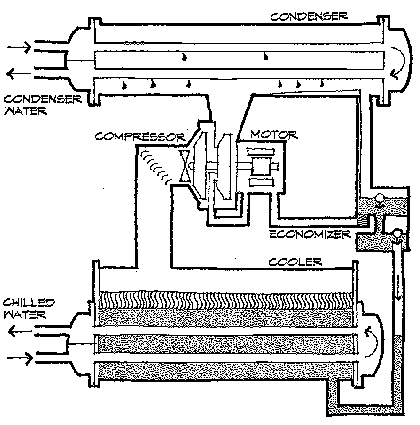
The Freon Ban has cost well over $1 trillion worldwide in new "ozone safe" chillers, massive machines that cool air like your home air conditioner. These new machines are 25% less efficient than the old Freon-12 machines - and the ozone layer is deteriorating at a faster rate now than when the Freon Ban was passed over ten years ago. New "ozone safer" freons are being phased in at this very moment, that are even less efficient and that are no more efficatious in helping the ozone layer.ExcerptsThe procedures are arranged in order of increasing expense and complexity. The more expensive projects should be justified on the basis of a system whose components have been optimized by implementation of the maintenance projects.6.1 Thermostat vigilanceThe thermostat is the remote control device for all the space conditioning equipment. It is a convenient means to monitor the space temperature and to control the equipment to use less energy while maintaining a comfortable environment. It is also a potential source of error in the system, and therefore of inefficiency and wasted energy.The first thing to notice about each unit thermostat is its location. It is usually located on an inside wall since exterior walls are usually not at the average room temperature. Another common practice is to situate thermostats near a return air grill to provide a constant flow of air across the element that is a typical sampling of air from the room. The location may have changed from the original design location because of remodeling so it is important to periodically verify locations and their environment.It is important not to locate the thermostat in direct sunlight. This causes higher than ambient temperatures reading. Locations near artificial heat sources are also to be avoided, such as copy machines, computer consoles, refrigerator compressor coils or simply an office worker with a space heater in his workspace. It also is important for the flow of air around the thermostat to be unrestricted. Putting the unit behind a door, curtains or filing cabinet isolates it from the space served and renders it quite inaccurate.The final course of action is simply to adjust the setpoint higher in the summer and lower in the winter. Ceiling fans help too. They move the air in the summer and, after reversing the direction of rotation, force warm at the ceiling down to the occupied zone in the winter. Relaxing dress codes will help in the hottest weather so people can cope better.6.2 Reduce use of radiant and electric strip heatersEnergy conscious designers cringe at a facility with all electric heating. This is the most inefficient and costly way to warm a space. Use of natural gas or oil to fire a boiler on the premises to heat water or generate steam for space heating is a much more effective and thrifty method. (Calculate the annual heat load, however, to verify this: if the load is very small then electric heat may not be that costly.)This principle transfers to the use of small electric heaters by occupants for personalized temperature control: They are wasteful fire hazards that should not be condoned by management or building operators.6.3 Clean condenser coils on dx unitsDirect expansion ("dx") air conditioning or heat pump systems have a outside condensing unit with finned coils. Air is drawn past these coil banks to extract heat from the refrigerant flowing inside the coiled loops of tubing. The fins on the tubing are there to increase the area of the heat exchange surface so that more heat can be transferred to the air stream. Anything that affects this surface area will reduce the heat transfer rate and therefore lower the efficiency of the unit.It is common for the fins to be damaged or disfigured. This can be fixed by combing the fins back to their original conditions and spacing. If the condensing unit is in a busy spot such as near a walkway or other location where the fins are constantly deformed, a metal guard should be installed to prevent this damage. These are available as factory accessories, and are often marketed as hail guards.The coils can also become fouled and dirty. This has an adverse affect on the efficiency of the unit and so the coils should be kept clean. This includes the fan blade, as a dash of mud solidified on the blade imbalances the fan and cause the bearings to wear and the motor to work harder to overcome the extra friction.6.4 Install timeclock controlsTime clocks are a simple and inexpensive way to reduce space conditioning costs. The equipment can be turned off at close of business every day so that cleaning crews or late working tenants do not keep the equipment running late. Even if only a single air handler in a large building is in operation extra hours the main chiller or boiler must stay on line, and both systems operate very inefficiently at low loading conditions. So the energy that is used is at a premium.Packaged systems can be controlled by a timer also. A school, for example, may have individual units for the classrooms, kitchen and gymnasium. These can all be controlled by a single timer set for the regular staff schedule. The timer can even be set to activate the units an hour early so conditions are favorable when everyone arrives. A local override timer in each space permits operation of the unit for a few hours when the rest of the units are off.6.5 Maintenance tasksLarge air handlers are usually located in their own mechanical rooms and are easily accessible for maintenance. The staff should be vigilant for air leaks at flex connections, filter sections and duct joints. It is especially important to staunch air leaking after the filter section as this will allow dirt and dust into the fan, coils and other critical parts of the air handler.Fan belts need to be inspected for tightness and wear so the full motor power will reach the fan and so an offset or imbalance will not cause extra wear on the motor or fan bearings. The fan and motor should be lubricated according to the manufacturer's guidelines for optimum performance.It is also important to change the return air filter regularly. Not only is the filter efficiency reduced when the filter gets dirty, it is also harder for air to flow through it and the air volume is diminished. As a result the air handler must operate longer to supply a fixed volume of conditioned air to a room to maintain conditions. This extra operating time is an unnecessary expense that can be avoided by changing out filters regularly.6.6 Unoccupied operationsGood design practice requires separate air conditioning systems for areas that are regularly eight hour occupancies and those that are 24 hour occupancies. This applies to hospitals, schools, factories and other facilities on an extended work schedule. If the business offices, for example, are on a different unit from the factory floor then either area can operate after hours without having to provide air conditioning to other large spaces that are not in use.6.7 Clean ductworkInternally lined ductwork can become quite dirty after many years of steady use. This increases the resistance to air flowing through it and reduces the volume of air that the supply air fan can move through the system. There will be a decrease in volume as static pressure increases.Replacing the ductwork is an expensive process that involves removing the ceiling throughout the building. Cleaning the existing ducts is a thrifty alternative. The dirt and grime is brushed off and vacuumed up by special equipment. Then the insulation is chemically treated and sealed, to counter any future threat to air quality.If the entire duct system cannot be refurbished in this manner, the main trunk line and the branch line most distant from the supply air fan can be cleaned. This has the most impact on reducing the static pressure at the fan to within the original design specifications. This also optimizes the efficiency of the entire air distribution system.
________________________________
banner advertising below this line
© 2002 WH Clark